" transform="translate(3 2)" width="14px"/></svg>)
Deep Dive

The questions to ask before an AI agent touches your TMS
AI agents can take much of the manual work behind updating a TMS off a rep’s plate, but only with a two-way integration in place.

Edwin Su
Integrations Engineer

Milan Jain
Partnerships Lead
Every minute a supply chain operator spends chasing an email, call, or text instead of serving customers is a hidden cost. We call it the coordination tax: the flood of manual updates operators must process to keep shipments moving. Agentic AI can now pay that tax, handling what reps once did one by one, which is why supply chain operators worldwide are exploring it to transform their business.
To leverage AI in your business, first answer three questions:
What tasks will you hand to an AI agent?
What is your operations team’s definition of success?
What is your board’s definition of success?
After you’ve completed that initial strategy work, your next step is to identify an AI partner that can act within the systems of record that your business already relies on. For brokers and carriers, the primary system of record is the transportation management system (TMS).
How AI agents work alongside your TMS
The supply chain runs on a variety of interconnected systems that function like a power grid. Customer portals send orders in, telematics report truck positions, EDI feeds push statuses back out, and accounting closes the file at the end. Each system must work alongside the others in order to keep the lights on.
The TMS is the heartbeat of these systems, but also the most time-consuming to manage — reps have to route every order, rate, appointment, and invoice through it.
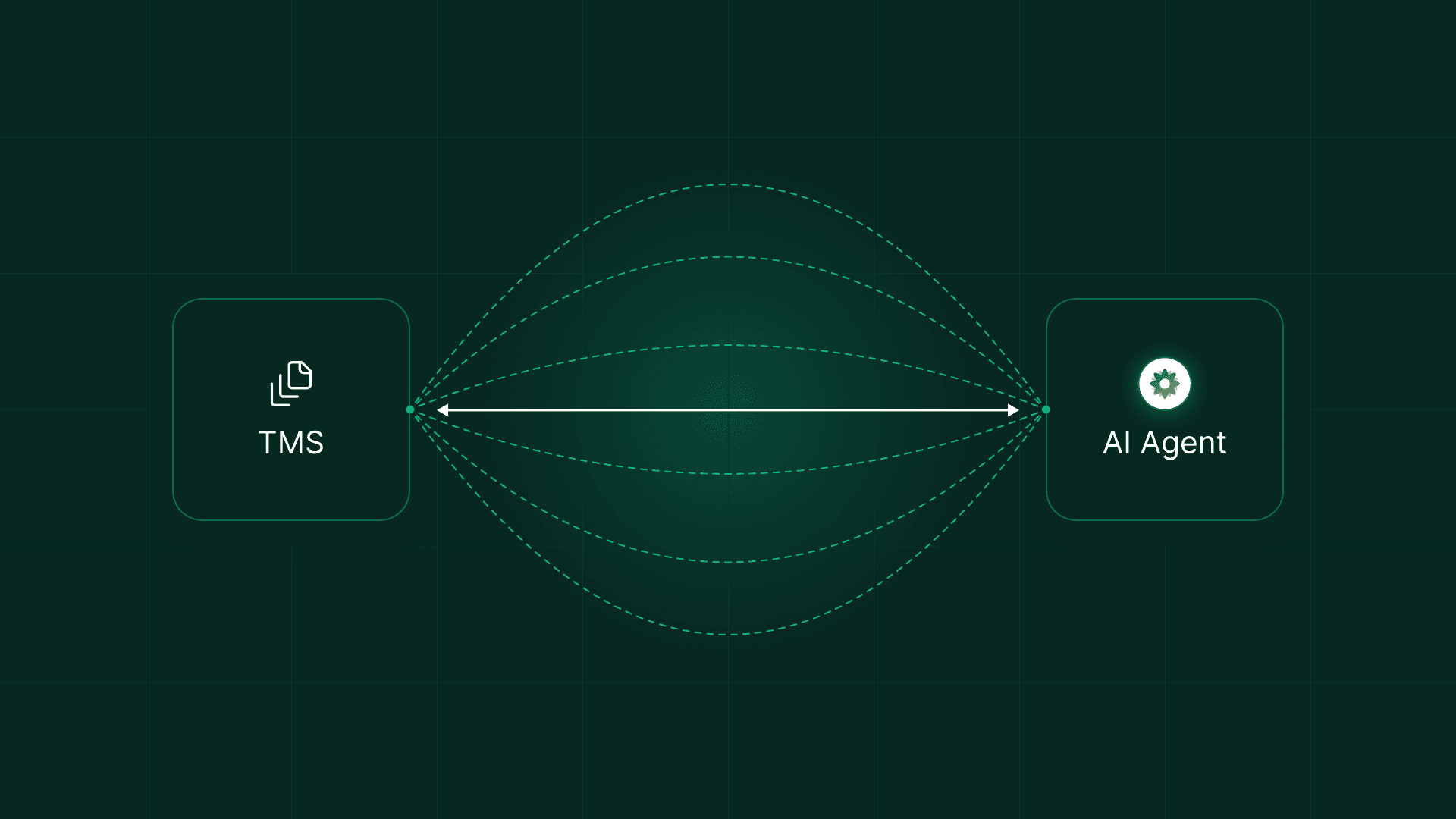
AI agents can take much of the manual work behind updating a TMS off a rep’s plate, but only with a two-way integration in place. A two-way integration means that an agent can read (or be provided notifications from) your TMS and write directly into it.
At Augment, we've built integrations across both the external and proprietary TMS platforms that power some of North America's largest brokerages and carriers. That work has shown us exactly what it takes for an integration to actually deliver value, not just exist on paper.
Many AI vendors claim they can integrate; but “integrate” can mean anything from a spreadsheet emailed on a timer to a certified, two-way integration.
Here's a framework to evaluate AI partners on what best-in-class integration should look like before having to put pen to paper.
Connected is not the same as integrated
Many AI vendors offer an API connection into a brokerage's or carrier's TMS. Through this capability, an AI agent can read and write fields in the TMS, but unlike a trained rep, the agent doesn’t know which values belong in those fields and when they should be added.
When an integration shares your organization’s ontology, an agent can act much more like a trained rep on your floor. This shared ontology allows the AI agent to know your status codes, classify your business objects, and understand how loads move from one status to the next.
Shared context allows an AI agent to act with high agency while enabling clean attribution; an operator can see exactly what the agent changed, when, and why.
The menu of integration paths
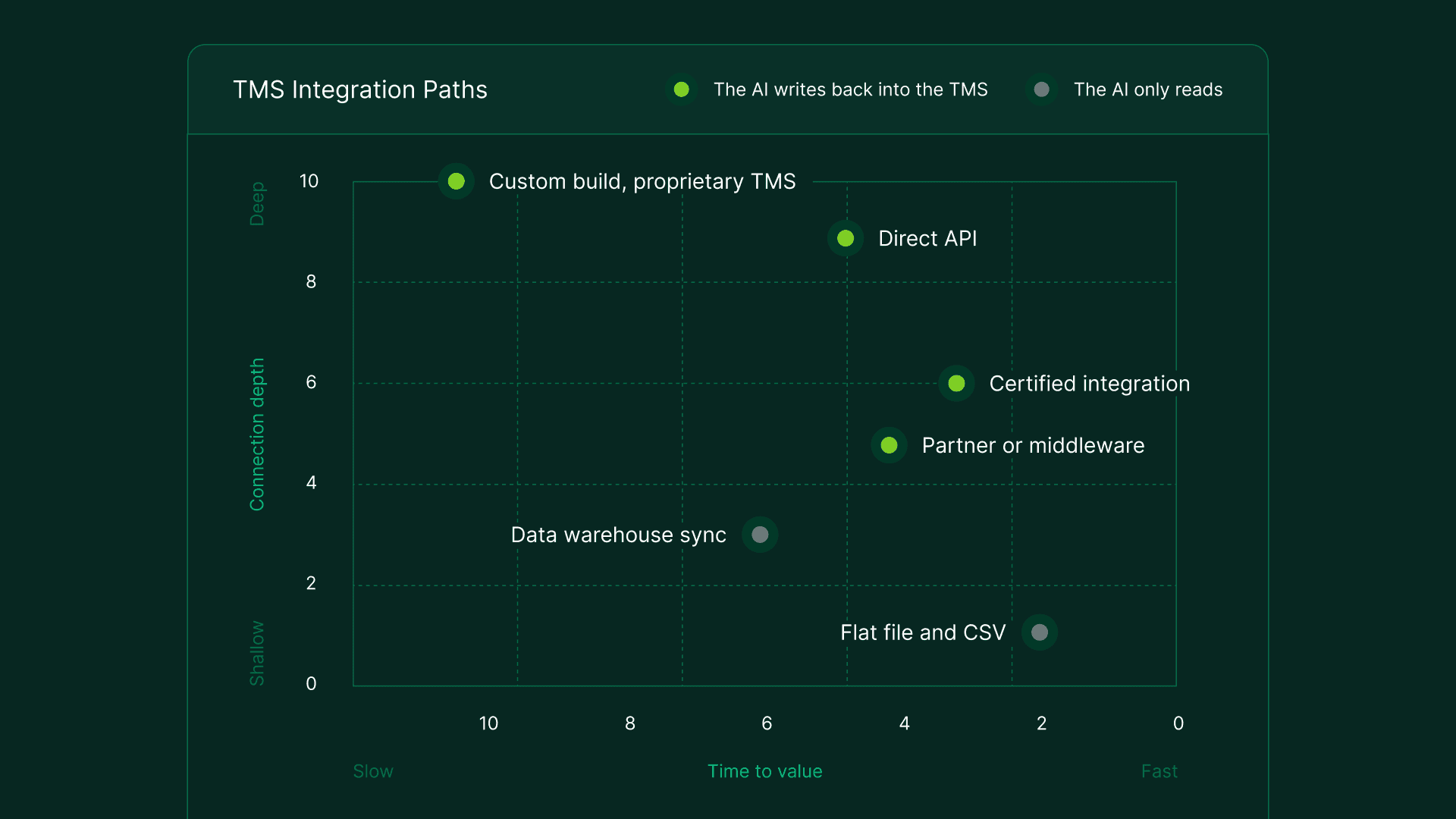
Below, we’ve outlined the integration paths available to supply chain operators seeking to onboard an AI vendor:
A direct API integration the AI vendor builds and owns: The AI vendor carries the engineering burden and maintains the connection through TMS releases. Data moves in real time or close to it. The AI writes back, so it updates statuses, appointment times, and notes in the system of record.
A custom build against a proprietary TMS: The AI vendor and the customer's engineering team split the developer burden, and the customer commits developer hours for endpoints, documentation, and a test environment. Data reaches the same freshness as a direct API integration once the connection is live. The AI writes back only where the customer exposes write endpoints, so ask which fields accept writes before you sign.
A certified integration through the TMS vendor's own program: The TMS vendor defines the contract and certifies the AI vendor against it, so the connection survives platform upgrades. Freshness depends on the program, because some programs cap call volume or refresh on a schedule instead of an event. Write-back reaches the fields the program exposes and no others, so ask for the field list.
A partner or middleware path: A third party owns the connection, and accountability splits three ways when something breaks. Every message requires an extra step. Write-back works, though the middleware's field mapping decides what actually lands in the TMS.
A data warehouse sync: The customer's data team owns the pipeline and the refresh cadence. The AI reads a copy of the day that is minutes or hours old. The AI cannot write back, because a warehouse records history and does not run operations. A warehouse sync supports analysis and reporting, but it cannot support execution.
Flat file and CSV ingestion: The customer's TMS writes out a file of loads, and the vendor writes results back to a file the TMS pulls in. The fastest path to stand up, stable once running, and easy for your organization to manage in the short term, which makes it a viable way to deliver value during implementation. The catch is that this path is generally asynchronous: files move on a timer, so data ages from the moment it's generated, and updates may be missed by the time an agent acts on those files.
What to confirm before granting write access
An AI agent that reads your data can report on your business. An AI agent that writes to your system of record can act on behalf of your business -- so the bar for granting write access should reflect that gap.
At some brokerages and carriers, building a single load can involve five or more API calls and 50+ fields. For an AI agent to accurately build a load in the TMS, operators need field-level confidence scores and deterministic guardrails encoded on top of the AI model for any field that can't afford to be wrong. Ideally, the performance of the AI agent should also improve over time, as operators step into to make corrections when confidence scores are low.
Error handling and rollback matter just as much.. If a write fails partway through, the agent needs to surface that to an operator immediately, so a load is not left sitting half-baked in the TMS without an update.
How to vet an integration before an AI agent touches production
Some TMS providers run certification programs, such as McLeod's program for ensuring partners deliver proven, fully supported and integrated solutions. If you use an external TMS with a certification program in place, ask whether the AI vendor you are evaluating is certified and what the certification is tested on beyond just the happy path.
Operators should also conduct sandbox testing, hands-on customer testing, and an observation period on production transactions before committing to an AI partner. Confirm upfront that the AI partner can support this testing and agree on exit criteria before beginning work together. There should be a passed test for every scenario required to drive operational success for your team, even when the anticipated test outcome is an escalation or failed execution.
Lastly, request references from customers who already run the AI and TMS integration in production today, since they will have knowledge gained from first-hand experience.
Questions to evaluate an AI partner’s integration capabilities with your TMS
Below we’ve provided a list of questions that can help you evaluate the depth of an AI agent’s integration capabilities with your TMS.
Security & Governance
What access does the agent need — read, write, or both — at what scope, and how do we revoke it?
What security audits have you undergone?
What SOC 2 compliance have you achieved?
How will our operators know what the agent did, and how do they correct or reverse it?
Reliability
Walk me through how one order gets created in our TMS end to end, including what happens when a call fails.
What happens when your agent is unsure about a field? Where is the confidence threshold, and what is deterministic?
Which workflows need real-time data, and can your integration path deliver it at our load volume?
When our TMS ships a version update, who maintains the integration and how long does it take?
Who runs this in production on our TMS today, and can I call them for a reference check?
Does your integration respect our TMS's API rate limits, and how do you handle throttling or overage at our load volume?
Functionality
Show me the ontology. How does our business data fit into your data model and infrastructure? How will you learn and apply what our statuses and codes mean, per customer and per facility?
If operators step into assist when confidence scores are low, how will performance of the AI agent improve if at all over time?
Does our TMS vendor have a certification program, and if so, are you in it? What did it test?
What do you need from our IT team, and what happens if our IT Team has limited resources to support this launch?
How to integrate AI agents with your TMS through Augment
Augment, the AI operating platform for supply chain, integrates with the top external TMS platforms brokers and carriers already use, including McLeod Software, Turvo, and dozens of others. We also build integrations with the proprietary TMS systems customers like NTG have built themselves. Connect with us to find out how Augie, our flagship AI teammate, can supplement your reps’ work within the systems they already use.
Meet Augie, the AI teammate built for supply chain.
Augie handles the daily grind so your operators can focus on service and scale.